

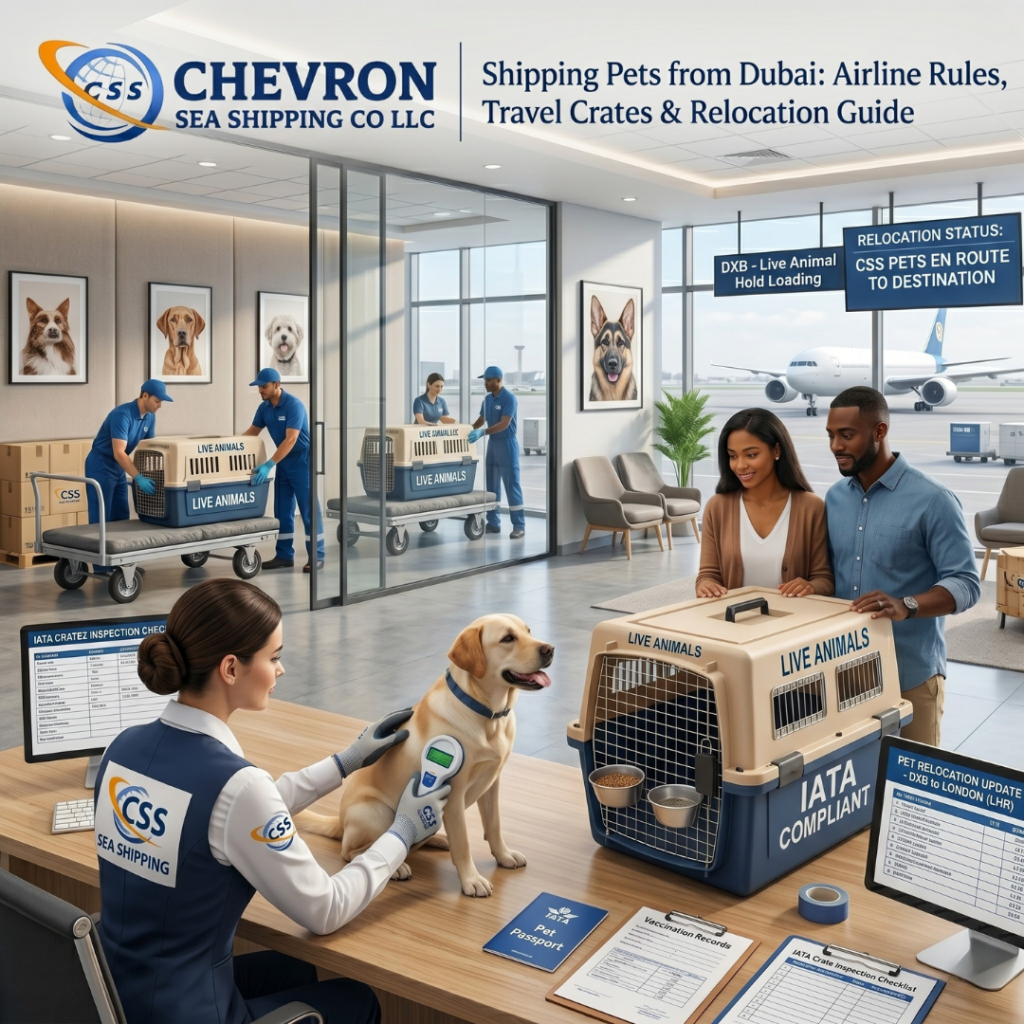
When you move internationally, you treat furniture and electronics as just “cargo.” But your dog or cat? They are family. Therefore, leaving them behind is simply not an option.
However, shipping a live animal across the world remains the most stressful part of any international move. Furthermore, authorities highly regulate this process. The rules are incredibly strict, and the paperwork gets complex. Consequently, the stakes could not be higher. For example, a single missing stamp on a veterinary certificate causes major issues. Similarly, a travel crate that measures two centimetres too small will result in cargo terminal staff turning your pet away in Dubai.
We know that flying your furry family members causes stress. Therefore, our expert pet relocation team created this complete guide. It will help you navigate the maze of airline rules and veterinary requirements. Ultimately, our export logistics ensure your pet arrives safely.
1. Manifest Cargo vs. Excess Baggage
How exactly will your pet fly out of the UAE?
- In-Cabin / Excess Baggage: Some airlines allow small pets to travel inside the cabin under the seat. Alternatively, they can fly as checked excess baggage on your flight. However, many countries (like the UK and Australia) strictly prohibit pets from arriving this way.
- Manifest Cargo: For most international relocations out of Dubai, your pet will fly as “Manifest Cargo.” This means airline staff place them in a special live-animal hold below the passenger deck. This area remains temperature-controlled and pressurised. Furthermore, authorities tightly regulate this safe method. Usually, you must book this ticket through a registered freight forwarder.
2. The Holy Grail: IATA-Approved Travel Crates
You cannot use a soft carrier or a wire-mesh cage to fly a pet as cargo. Instead, the crate must comply with IATA (International Air Transport Association) standards.
- Size Matters: This represents the number one reason airport staff reject pets. The crate must offer enough space. Specifically, your pet must stand up, turn around naturally, and lie down comfortably.
- The Construction: The crate must feature rigid plastic or wood. Additionally, you must bolt it securely together without using plastic clips. It must also include a secure metal grate door and ventilation on all four sides.
- Accessories: The crate requires attachable food and water funnels. Consequently, airport staff can hydrate your pet without opening the door.
- Pro Tip: Buy the crate weeks in advance. Next, leave it open in your living room with treats inside. Crate-training your pet before the flight dramatically reduces their travel anxiety.
3. The Paperwork Maze (Vaccinations and Microchips)
Every country enforces different import rules. However, the baseline requirements from the UAE remain universal:
- Microchip: Your pet must possess an ISO-compliant 15-digit microchip. Furthermore, the vet must administer this before giving any rabies vaccinations.
- Rabies Vaccination: This shot must remain up-to-date. Usually, vets administer it at least 21 days before travel, but less than one year prior.
- The RNATT (Rabies Neutralising Antibody Titre Test): Are you relocating to countries with strict import requirements, such as the EU, UK, Australia, or New Zealand? If so, your pet needs a Rabies Neutralising Antibody Titre Test (RNATT). The vet sends this blood test to an approved lab to prove the rabies vaccine worked. Warning: Some countries require you to wait three to six months after this blood test before your pet can enter!
4. Export and Import Permits
Your pet needs travel documents just like you do.
- UAE Export Permit: We handle the export health certificate. The UAE Ministry of Climate Change and Environment (MOCCAE) issues this document. You need it for exporting any animal from Dubai.
- Destination Import Permit: Depending on your destination, you may need a pre-approved import permit. The destination government (e.g., DEFRA in the UK, or the CDC/USDA in the USA) handles this.
5. Breed Restrictions (The “Snub-Nosed” Rule)
Airlines continually become more strict about which breeds they allow on board. Primarily, they do this due to health and safety concerns.
- Brachycephalic Breeds: “Flat-faced” or snub-nosed breeds have compromised respiratory systems. For instance, this includes Pugs, French Bulldogs, Persian cats, and British Shorthairs.
- The Embargo: Most major airlines (including Emirates) place strict embargoes on flying these breeds. They enforce this especially during the hot UAE summer months. These animals remain highly susceptible to heatstroke and breathing difficulties at altitude. Therefore, if you own a snub-nosed breed, you must plan your relocation well in advance. This ensures you secure spots on specific, pet-friendly airlines.
Fly Your Pet with Complete Peace of Mind
Do not leave your pet’s travel arrangements to the last minute. The veterinary timelines alone can take months to complete. Instead, let the compassionate experts at Chevron Sea Shipping handle the complex details.
We manage flight bookings, MOCCAE permits, and airport logistics. Consequently, you can focus entirely on welcoming your best friend to their new home.
Start planning your pet’s relocation today. Contact our dedicated pet transport coordinators.
- 📞 Direct Line / WhatsApp: +971 54 400 6210
- 📧 Email: [email protected]