

You wouldn’t pack a million-dirham contemporary canvas the same way you pack a toaster. Similarly, a 200-year-old antique vase requires special care. Moving high-value art isn’t just logistics. In fact, it is preservation.
In Dubai, the stakes are enormous. Gallery directors ferry entire exhibitions to London. Meanwhile, private collectors relocate their most precious sculptures to new villas in Emirates Hills. Furthermore, Dubai has quickly become a global hub for fine art. The city features world-class galleries and international shows like Art Dubai. Consequently, it boasts an expanding community of private collectors.
A single scratch or a minor shift in humidity causes huge problems. Likewise, a careless drop can instantly destroy a masterpiece. Ultimately, these accidents ruin both the aesthetic and financial value of the art.
When it comes to fine art and antiquities, you need a white-glove division. Specifically, you need experts who specialise in handling, crating, and transport. Chevron Sea Shipping provides exactly that service. Below, we explain how we keep your irreplaceable pieces safe. We protect them from the moment they leave the wall until they arrive at their new destination.
1. The Danger of Standard Materials (Why Bubble Wrap Fails)
The biggest mistake amateur movers make involves treating a painting like standard furniture.
- The Moisture Trap: Wrapping an oil painting directly in standard plastic bubble wrap causes a catastrophic error in the UAE climate. Simply put, plastic traps humidity. When the temperature fluctuates, condensation forms rapidly. Consequently, the plastic can literally melt into the varnish or paint layer. Therefore, this mistake completely ruins the artwork.
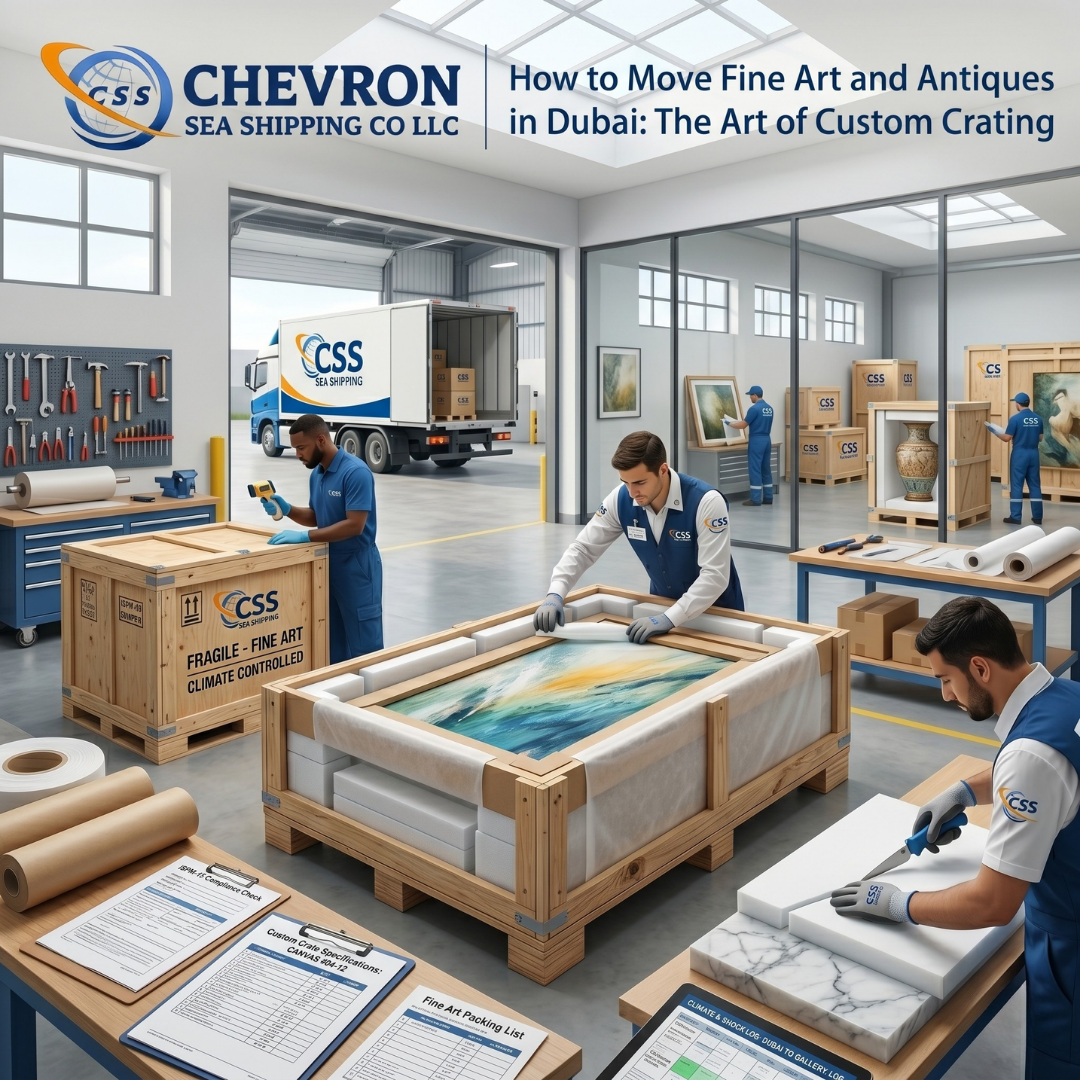
- Archival Wrapping: We only use museum-grade, acid-free materials. First, our team wraps paintings in breathable Glassine paper or Tyvek. This material protects the surface from friction, dust, and moisture. Most importantly, it does not trap heat. After that, we apply specialised corner protectors and rigid cardboard collars. Finally, the crating phase begins.
2. Bespoke Wooden Crating: The Ultimate Armour
A cardboard box will never protect a marble bust or a framed canvas. Specifically, it cannot absorb the vibrations of a cargo flight. Additionally, it fails against the sway of an ocean vessel.
- Custom Engineering: We strictly avoid “off-the-shelf” crates. Instead, our in-house carpenters measure every single dimension of your artwork. Subsequently, they build a bespoke, reinforced wooden crate specifically for that individual piece.
- Shock Absorption: A crate remains useless if the art bounces around inside it. Therefore, we equip our crates with high-density Ethafoam. We cut this foam with the utmost precision. Furthermore, we line the inside with shock-absorbing barriers. These barriers effectively suspend the art in mid-air. As a result, they isolate the piece from external impacts and vibrations.
- ISPM-15 Compliance: When travelling internationally, the wood used for the crate must be heat-treated. It must also carry a stamp to meet ISPM-15 international standards. If it lacks this stamp, destination customs will quarantine the shipment. Moreover, they might potentially destroy the crate. Ultimately, this will severely delay your artwork.
3. Climate-Controlled Transport
Art remains highly sensitive to its environment. For example, wood expands under rapid changes in temperature. Likewise, canvas warps and paint cracks.
- Therefore, we move your art from your home or gallery to our facility safely. We utilize climate-controlled, air-ride suspension vehicles for this journey.
- For international air freight, we book your pieces on direct flights whenever possible. This strategy significantly minimises tarmac exposure. Additionally, we work closely with airport cargo handlers. We ensure they keep the crates in temperature-controlled holding areas at all times.
4. Navigating Fine Art Customs and Provenance
Importing and exporting high-value art attracts the immediate attention of customs authorities.
- Valuation and Proof: You must provide clear commercial invoices and certificates of authenticity. Additionally, you need solid proof of ownership. If customs suspects an item represents a protected cultural antiquity, they will hold the shipment immediately. Consequently, they will launch a massive investigation.
- Temporary Imports for Galleries: Perhaps you are bringing art into the UAE for a temporary exhibition. If you plan to return it to the origin country, we utilise an ATA Carnet or a temporary import bond. Because of this, you do not have to pay the standard 5% UAE customs duty on visiting pieces.
5. Specialised “All-Risk” Fine Art Insurance
Standard household goods moving insurance calculates payouts based on weight and standard depreciation. Obviously, that approach does not work for a Picasso.
- Instead, we arrange specialised Transit Fine Art Insurance through premium underwriters. This process requires a professional appraisal and a condition report before packing begins.
- Ultimately, this guarantees your financial investment remains fully protected at its actual market value from “nail to nail.”
Preserve Your Masterpieces with Chevron
Do not trust your private collection or gallery inventory to a standard freight forwarder. Handling fine art requires a gentle touch and engineering precision. Furthermore, it demands a deep respect for the art itself.
Contact our specialist fine art handlers today. We will arrange a confidential consultation and a custom crating assessment for you.
- 📞 Direct Line / WhatsApp: +971 54 400 6210
- 📧 Email: [email protected]