

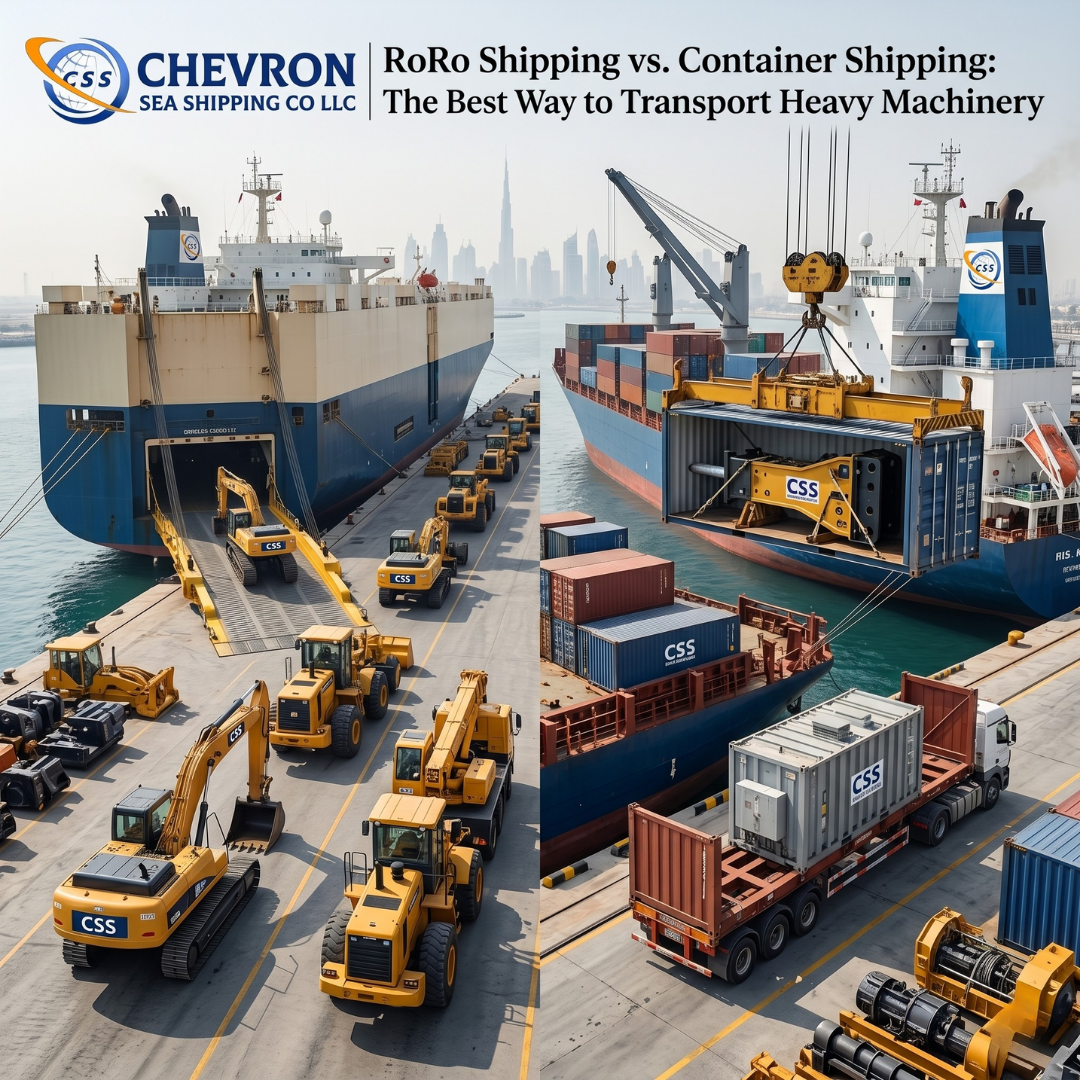

You have just purchased a fleet of earth-moving excavators from a supplier in Dubai, and you need them on your construction site in Africa by next month. Now comes the million-dollar logistics question: How do you actually ship them?
Dubai is a massive global transit hub for heavy machinery, agricultural equipment, and construction vehicles. But a 30-ton bulldozer doesn’t cross the ocean as easily as a pallet of electronics. You are dealing with extreme weights, awkward dimensions, and specialised port handling.
When it comes to exporting heavy machinery, you generally have two main options: RoRo (Roll-On/Roll-Off) or Container Shipping (including specialised Flat Racks). Choosing the wrong method can result in severe transit delays, blown budgets, or damaged equipment.
At Chevron Sea Shipping, we handle heavy equipment logistics for the industrial sector. Here is our expert breakdown of RoRo versus Container shipping, and how to choose the right method for your machinery.
1. RoRo Shipping: The “Drive-On” Solution
RoRo stands for Roll-On/Roll-Off. These massive, specialised vessels act like floating multi-story parking garages.
- How it Works: If your machinery is drivable (like a tractor, motor grader, or mobile crane) or can be towed on a trailer, it is simply driven up the ship’s ramp and parked securely on one of the heavy-duty decks.
The Pros:
- Cost-Effective for Oversized Cargo: You are charged based on the machine’s footprint (Length x Width x Height). There are no expensive crane-lifting fees (Terminal Handling Charges) at the ports because the machine is driven on and off the ship.
- No Dismantling Required: The machine ships exactly as it is. It arrives at the destination port ready to drive straight to the job site.
The Cons:
- Exposure: Your equipment is often exposed to the open air on the dock while waiting to load, and sometimes on the deck during transit (though under-deck parking is usually preferred).
- Limited Routes: RoRo ships do not operate on a regular schedule like container ships, but instead call at specific ports that have RoRo ramps.
2. Container Shipping: The “Sealed Box” Method
If your machinery fits in a standard 20ft, 40ft or 40ft High Cube container, this is usually the default option for global trade.
- How it works: The equipment is placed into a steel container, strapped down tightly to the floor, and the doors are sealed. Cranes lift the box onto a large container ship.
The Pros:
- Total Protection: The machine is fully protected from the harsh marine environment, salt spray, and the risk of theft or vandalism at ports.
- Global Reach & Speed: Container vessels are on tight, regular weekly schedules to virtually every commercial port in the world, providing you with much faster and more flexible transit options.
The Cons:
- The Dismantling Hurdle: Most heavy machinery (like large excavators) is too tall or too wide to fit through the doors of a standard container. To use this method, you must pay mechanics to dismantle the cab, the tracks, or the boom arm, and then pay mechanics again at the destination to reassemble and test the machine.
3. The Hybrid Option: Flat Racks and Open Tops
What if your machine is too big for a standard container, but you still want the route flexibility of a container ship, or the destination port doesn’t accept RoRo?
- Flat Racks: These are specialised shipping containers with no side walls and no roof—just a heavy-duty floor and two end-walls. The machinery is lifted onto the Flat Rack by a crane and lashed down. Because the cargo sticks out the sides and top (Out-of-Gauge), the shipping line cannot stack other containers on top of it.
- The Catch: Flat Racks are the most expensive option. You pay a premium because your oversized cargo occupies multiple container slots on the vessel.
4. Which Method Should You Choose?
The decision ultimately comes down to mathematics and engineering:
- Is it drivable? If yes, and it is massively oversized, RoRo is almost always the most cost-effective solution.
- Can it be easily dismantled? If taking the bucket and tracks off an excavator reduces its dimensions enough to slide it into a standard 40ft High Cube container, Container Shipping will usually save you money and get it there faster.
- Is it a static, oversized piece? If you are shipping a massive factory transformer that has no wheels and doesn’t fit in a box, a Flat Rack (or Breakbulk lifting) is your only option.
Heavy Lifting Requires Expert Planning
You cannot afford to rely on guesswork when shipping million-dollar construction assets. Let Chevron Sea Shipping run the cost-benefit analysis for your specific cargo.
We will measure the machinery, assess the capabilities of the destination port, and provide the most secure, cost-effective shipping strategy.
Consult with our heavy machinery logistics team today for a tailored shipping quote.
- 📞 Direct Line / WhatsApp: +971 54 400 6210
- 📧 Email: [email protected]