

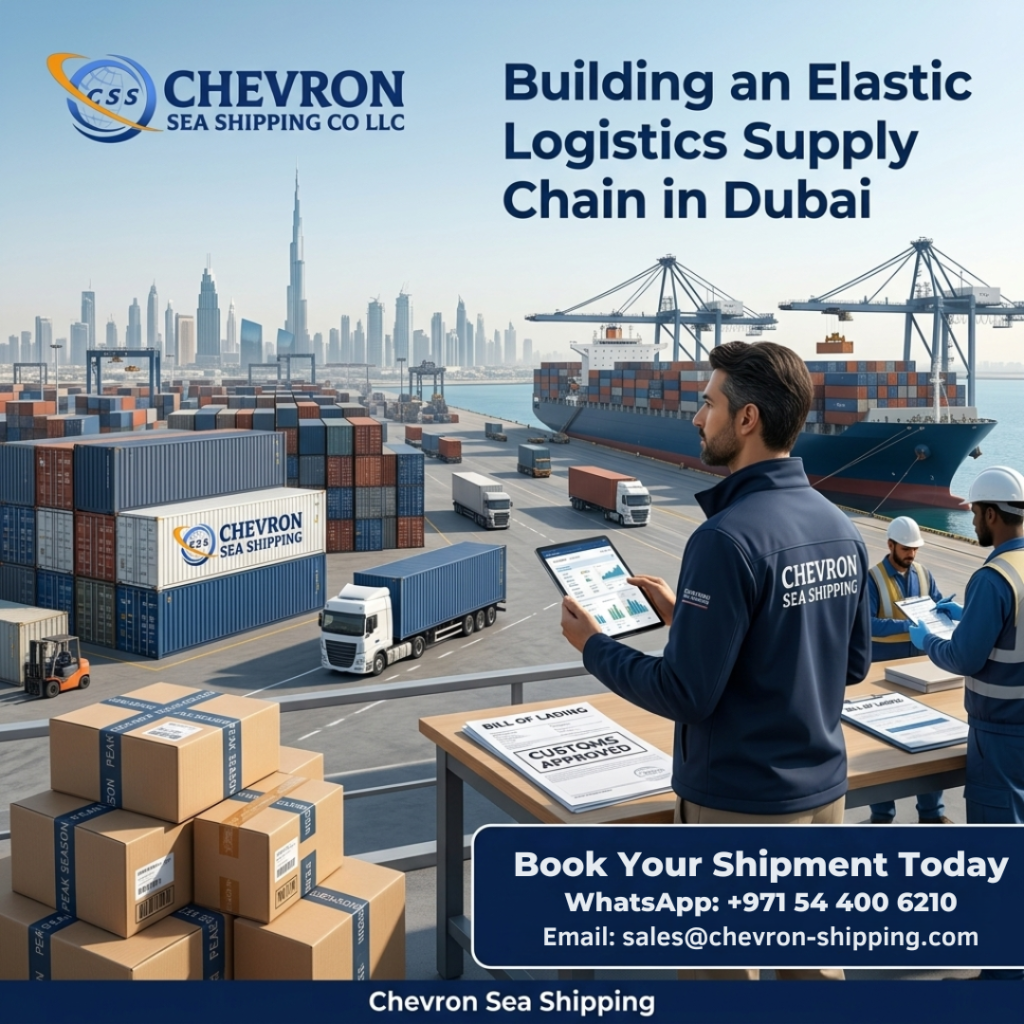
First, doing business in the UAE often feels unpredictable. For instance, retail brands frequently see a staggering 500% increase in orders during White Fridays, Ramadan, and Eid. Conversely, the summer months often become significantly slower. Therefore, a supply chain consisting of rigid, fixed assets can destroy your profitability if it fails to adapt.
Specifically, if you own your warehouse and fixed delivery fleet, your overhead remains consistent. Unfortunately, this means you pay for space and idle vehicles when orders fall. Moreover, when orders spike, you face massive capacity issues that result in lost customers. Consequently, many forward-thinking businesses in Dubai now transition to an Elastic Logistics Supply Chain. At Chevron Sea Shipping, we help brands shift from a “fixed-asset” mindset to a highly “scalable-service” model. Below, we explain how you can design your supply chain to reflect your actual service demand.
1. The Core of Elasticity: Fixed vs. Variable Costs
Elastic logistics maintains one easy-to-understand objective: convert fixed capital expenditures into variable operating expenses.
- Rather than spending millions on a private distribution center, utilize our Third-Party Logistics fulfillment network.
- Once your order volume increases, we adjust our dedicated space and packing staff accordingly.
- Consequently, when demand decreases, you immediately scale back.
- Most importantly, you only pay based on actual space used and orders processed. Thus, you never pay for “ghost” warehouse capacity.
2. On-Demand Transport and Distribution
Delivery vans should never act as a fixed cost. Unfortunately, one of the largest resource wastes for UAE SMEs involves maintaining a fleet that sits unused for half the month.
- The Elastic Approach: We utilize on-demand distribution. Furthermore, we manage hub-and-spoke circulation by consolidating goods at our main hub.
- Scalability: If a regional marketing campaign causes a massive sales spike, our network deploys as many vans as you need to clear the backlog. Ultimately, you gain enterprise-level delivery capacity without the fixed costs associated with an enterprise-level fleet.
3. Data-Driven Inventory Management
If you cannot see your inventory, you cannot scale it. Because elastic logistics rely on technology, they require high visibility.
- WMS Integration: Our Warehouse Management System integrates directly with your e-commerce platforms. Consequently, this provides real-time visibility of inventory across all sales channels.
- Predictive Replenishment: Furthermore, advanced analytics classify your “hot” high-demand items. We then predict and shift selling items to high-velocity zones in our warehouses. Ultimately, this decreases the time required to process every order.
4. Scaling Across Borders
Business elasticity should go far beyond Dubai. If you are a UAE company wanting to expand into Saudi Arabia, Oman, or Qatar, building a private supply chain in every country remains too slow, expensive, and risky.
- Global Partner Network: Chevron maintains a wide range of partners across different regions.
- If you want to sell to Riyadh, Manama, or Kuwait City, we have storage and last-mile solutions ready immediately.
- Consequently, you gain a local’s speed to enter a market at a fraction of a multinational’s cost.
5. Resilience Through Flexibility
The UAE market experiences fast and unpredictable changes. Unfortunately, a rigid supply chain structure often snaps under pressure. Whether facing abrupt regulatory changes or worldwide disruptions, you need a buffer. Elastic logistics provides exactly that vital buffer.
Design to Scale, Not Just to Fill
Your logistics should facilitate the growth of your company, not the opposite. Stop paying for space you do not utilize and stop losing customers due to your inability to grow. Partner with Chevron Sea Shipping to create an elastic logistics supply chain that moves your business, regardless of market conditions.
- 📞 Direct Line / WhatsApp: +971 54 400 6210
- 📧 Email: [email protected]