

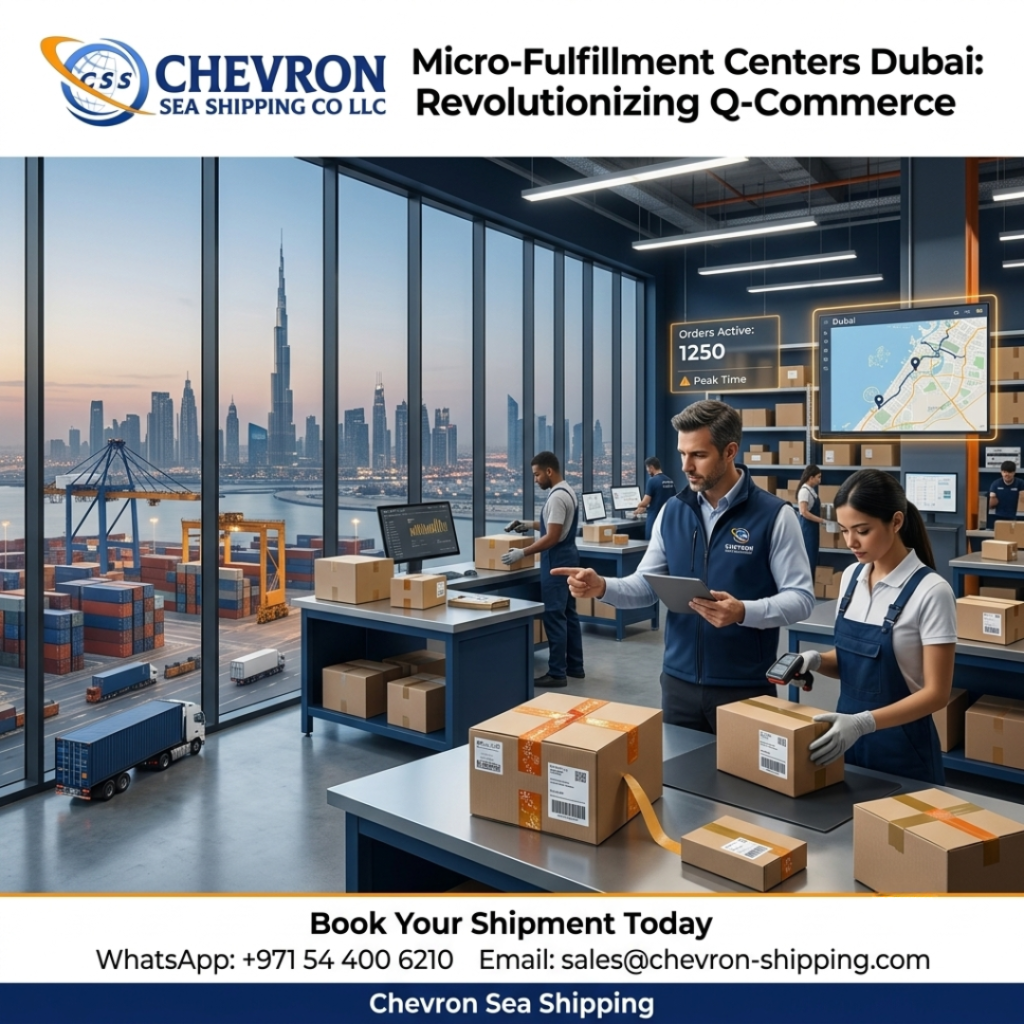
First, the term “fast” is officially outdated in most of the world. Conversely, in Dubai, consumers increasingly expect “Q-commerce” (Quick Commerce). Specifically, they demand that groceries, electronics, and consumer goods arrive within mere hours, not days.
Traditionally, e-commerce brands established large, centralized fulfillment centers on the city periphery. However, Dubai’s unique traffic and high population density make this standard too slow for modern customers. Indeed, the time required to transport goods from out-of-town warehouses to the city center exceeds acceptable limits. Therefore, Micro-Fulfillment Centers (MFCs) provide the essential answer for modern logistics.
Chevron Sea Shipping reports massive change as clients rapidly shift toward decentralized, urban-focused systems. Below, we outline how these hubs are essential to your brand’s business in 2026.
1. What are Micro-Fulfillment Centers Dubai?
Micro-Fulfillment Centers are advanced, automated storage systems typically ranging from 3,000 to 10,000 square feet.
- Unlike regional centers, MFCs are embedded directly within urban centers.
- Facilities are often housed in light industrial spaces, repurposed retail locations, or “dark stores”.
- By storing goods within a few kilometers of customers, companies substantially reduce the final leg of the supply chain.
- Consequently, this approach significantly cuts both the time and costs associated with last-mile delivery.
2. Why Dubai is the Perfect Testing Ground
Dubai’s geography presents a unique, lucrative opportunity for the MFC model.
- Concentrated Demand: High-density areas like Business Bay, JLT, and Marina contain significant population concentrations. Consequently, one MFC can cater to tens of thousands of people within a 15-minute delivery radius.
- E-Commerce Maturity: The UAE is developing a robust e-commerce ecosystem projected to be valued at $9.2 billion in 2026. Therefore, customers are tech-savvy and demand high service standards.
- Addressing Challenges: Even with improved addressing systems like Makani and Onwani, last-mile delivery remains difficult due to gated communities and traffic. However, placing inventory near the customer minimizes these unsuccessful delivery factors.
3. The Competitive Advantage: Speed and Cost Efficiency
MFCs allow companies to turn substantial costs into a competitive advantage, especially since last-mile delivery represents over 50% of total delivery costs.
- Hyper-Local Delivery: Because the final leg is shortened to just a few kilometers, companies can employ efficient methods like e-bikes and small vans instead of costly express couriers.
- Reduced Basket Abandonment: Conversion rates increase significantly when customers see that their order “will arrive today”.
- Inventory Agility: MFCs use real-time AI demand forecasting to carry only fast-moving SKUs. Thus, in-demand stock ships out in the quickest time possible.
4. Technology: The Core of the MFC
An MFC acts as a high-tech warehouse node rather than a miniature version of a large warehouse.
- Automated Picking: Tall, dense storage paired with robotics enables employees to pick and pack orders in about 10 minutes.
- AI Demand Forecasting: Sophisticated systems automatically replenish stocks before they sell out.
- Integrated WMS: Our Warehouse Management System offers complete transparency, allowing you to monitor the inventory status of all micro-hubs on one screen.
Modernizing Your Supply Chain
The “big warehouse” model is becoming the contracting norm. To successfully operate in Dubai’s future retail space, brands must adopt distributed fulfillment. Integrating MFCs into your network is a necessity in the Q-commerce arena, regardless of your company’s size.
Do you want to move your inventory closer to your customers?
Call Chevron Sea Shipping to get connected to our urban micro-fulfillment network and integrate your logistics.
- 📞 Direct Line / WhatsApp: +971 54 400 6210
- 📧 Email: [email protected]