

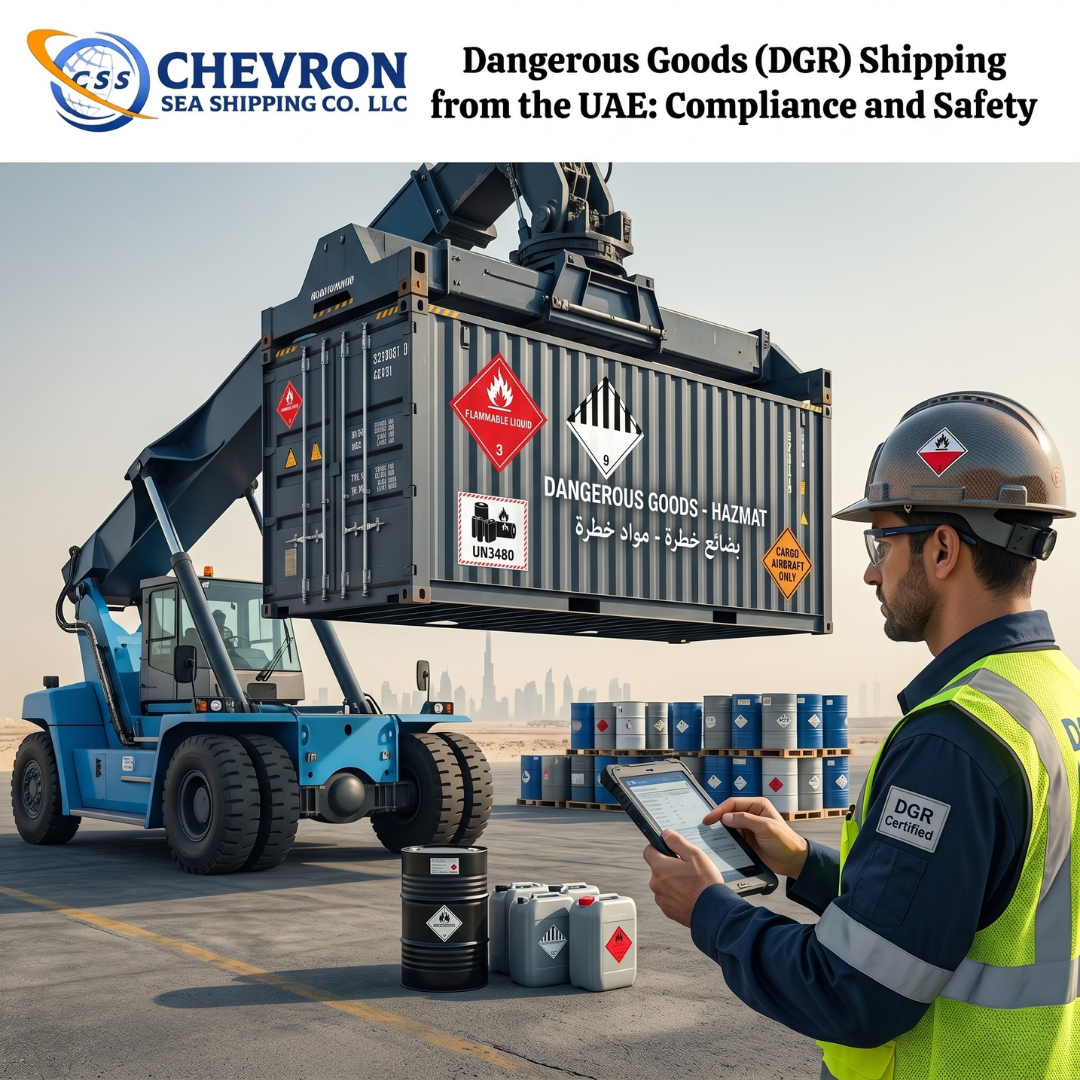
In the world of logistics, a single undeclared lithium battery can bring a multi-million-dollar supply chain to a grinding halt.
Shipping “Dangerous Goods” (DGR) or hazardous materials (Hazmat) out of the UAE is one of the most heavily regulated processes in global trade. It isn’t just about avoiding port fines; it is about protecting aircraft, cargo vessels, and human lives from fires, explosions, and toxic leaks.
Many businesses assume that “Dangerous Goods” only refers to industrial chemicals or radioactive waste. But every day, commercial products—such as perfumes, nail polish, smartphone batteries, and industrial paint—fall under strict DGR regulations.
At Chevron Sea Shipping, our certified DGR experts handle complex hazardous shipments daily. If your business needs to export restricted items from Dubai, here is what you need to know about staying compliant.
1. Identifying the 9 Classes of Dangerous Goods
The United Nations categorizes hazardous materials into 9 distinct classes. You must know exactly where your product fits before it ever reaches the port:
- Explosives: (e.g., fireworks, flares)
- Gases: (e.g., compressed air, aerosols, fire extinguishers)
- Flammable Liquids: (e.g., paints, alcohols, perfumes, acetone)
- Flammable Solids: (e.g., matches, sulfur)
- Oxidizing Substances: (e.g., hydrogen peroxide, fertilizers)
- Toxic & Infectious Substances: (e.g., pesticides, medical waste)
- Radioactive Material: (e.g., specific medical or industrial equipment)
- Corrosives: (e.g., battery acids, dyes)
- Miscellaneous Dangerous Goods: (e.g., dry ice, lithium-ion batteries, magnetized materials)
2. IATA (Air) vs. IMDG (Sea) Regulations
The mode of transport dictates the rulebook.
- Air Freight (IATA): The International Air Transport Association has a zero-tolerance policy for DGR errors. Because of the pressure and temperature changes at 30,000 feet, air freight regulations are incredibly strict. Some items that are perfectly fine to ship by sea are strictly embargoed on passenger and cargo aircraft.
- Sea Freight (IMDG): The International Maritime Dangerous Goods code governs ocean freight. While sea transport allows for the transport of larger volumes of hazardous materials, stowage rules dictate exactly where the container must be placed on the ship (e.g., “on deck only” or “away from heat sources”).
3. The Lifeline of DGR: The MSDS Document
You cannot ship dangerous goods without a Material Safety Data Sheet (MSDS) or Safety Data Sheet (SDS).
This document, provided by the manufacturer, details the product’s chemical composition, UN number, flashpoint, and handling instructions.
- Our Process: Before we accept a DGR booking, our certified team reviews your MSDS. We use this to determine the exact packaging requirements, the permitted quantities per package, and the correct transport mode.
4. UN-Certified Packaging and Labeling
You cannot pack a flammable liquid in a standard cardboard box.
- Specialized Packaging: DGR cargo must be packed in UN-certified drums, jerricans, or heavy-duty fiberboard boxes that have been rigorously drop-tested and pressure-tested.
- Strict Labeling: The outside of the package must display the correct hazard diamond labels, orientation arrows, the UN number, and the proper shipping name. If a label is missing, placed crookedly, or covered by tape, airport or port security will immediately reject the shipment.
5. The Dangerous Goods Declaration (DGD)
This is the final, legally binding document. The shipper (or their certified agent) must sign a Dangerous Goods Declaration stating that the cargo has been packed, labeled, and declared in accordance with international law.
- The Risk: Falsifying or making an error on a DGD is a criminal offense in many jurisdictions.
- The Chevron Advantage: Our DGR-certified staff are authorized to prepare and sign the DGD on your behalf, ensuring absolute accuracy and compliance so your cargo boards the vessel or aircraft without delay.
Ship Safely with Certified Experts
Do not risk your cargo, your company’s reputation, or public safety by mishandling hazardous materials. Partner with a logistics provider that has the certifications, the training, and the strict operational protocols to move your DGR freight legally and safely.
Consult our DGR specialists today to review your MSDS and secure a compliant shipping quote.
- 📞 Direct Line / WhatsApp: +971 54 400 6210
- 📧 Email: [email protected]