

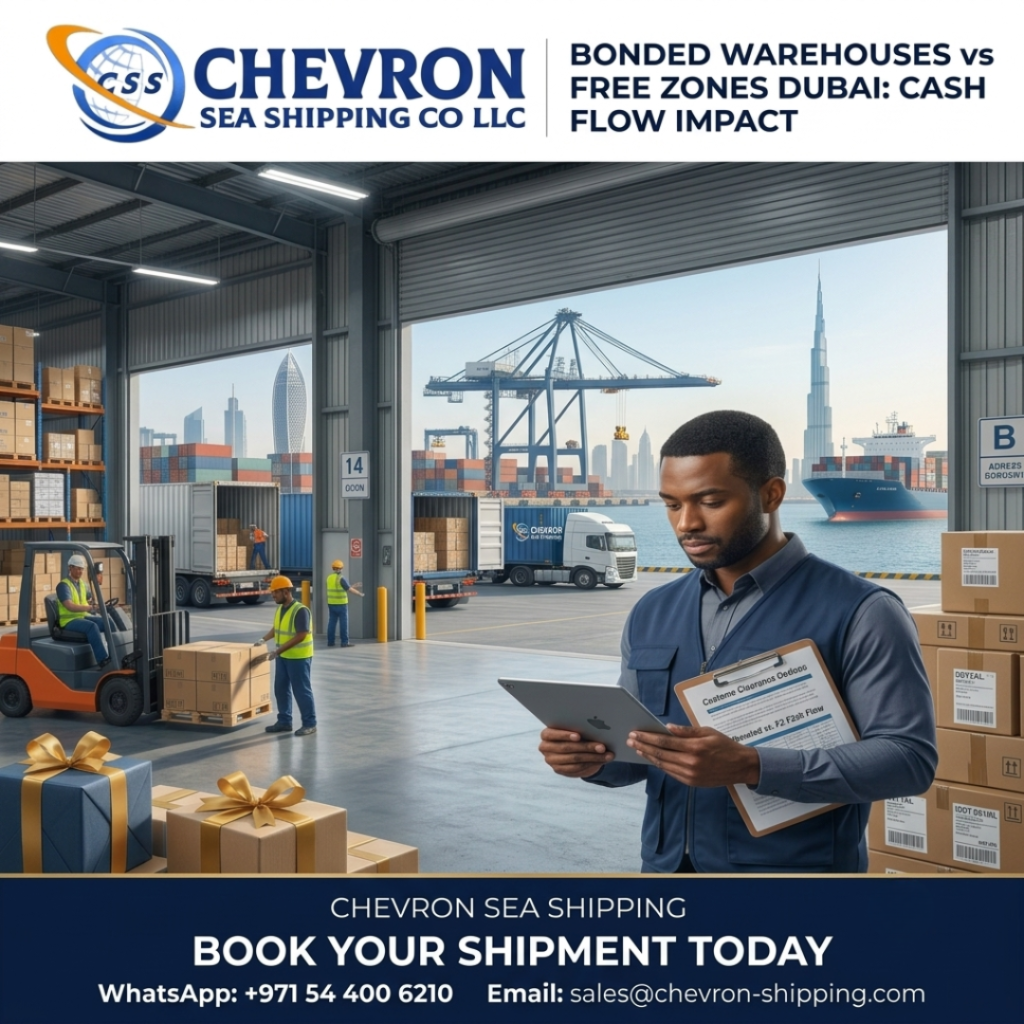
First, each time a commercial shipment arrives at Jebel Ali, importers face a significant financial decision. Specifically, do you clear customs right away? Doing so means paying the 5% import duty instantly. Consequently, this actively locks up a huge amount of working capital long before you ever make a sale.
If your shipment consists of low-value, fast-moving consumer goods, paying the duty immediately might remain the best decision. Conversely, your shipment might contain high-value electronics, luxury vehicles, or bulk raw materials. In these cases, paying the full customs duty upon arrival creates a significant and completely unnecessary cash flow problem.
Fortunately, the United Arab Emirates designed two different logistical systems specifically to solve this exact pain point. Namely, importers use the Customs Bonded Warehouse and the Free Trade Zone (FTZ), such as JAFZA or DAFZA.
While both systems allow you to store imported goods without paying customs duty, they operate under completely different legal frameworks. Furthermore, they serve entirely different business models. If you select the incorrect system, you may face severe operational restrictions. Additionally, you might end up paying for unnecessary premium warehouse space.
At Chevron Sea Shipping, we operate seamlessly within both systems. Below, we summarize the actual differences between Bonded Warehouses vs Free Zones in Dubai. Ultimately, we help you decide which one best safeguards your working capital.
1. The Primary Distinction: Deferral vs. Exemption
The simplest way to explain this distinction involves looking closely at the final destination of your cargo.
- Bonded Warehouses (Duty Deferral): First, bonded warehouses allow for strict duty deferral. When your goods enter the UAE, the customs system essentially ‘pauses’ the taxes. Consequently, duty becomes payable only when goods officially leave the warehouse to enter the local mainland market.
- Free Zones (Duty Exemption): Alternatively, Free Zones allow for complete duty exemption. Customs officially treats Free Zones as fully offshore entities. Therefore, goods can enter, remain, and be modified or exported to other destinations completely without exposure to UAE customs duties or VAT.
2. The Customs Bonded Warehouse Model
A bonded warehouse represents a highly secure facility located directly on the UAE mainland. Furthermore, it operates under the strict oversight of Dubai Customs.
- How it Protects Cash Flow: Imagine you import AED 5 million of holiday season stock. Normally, you would pay AED 250,000 in duties in September. However, by placing that stock in a bonded warehouse, you completely avoid paying that upfront duty. Later, in November, you withdraw stock worth AED 1 million for a local trade. At that exact moment, you only pay AED 50,000 in duty. Therefore, your duty payments perfectly align with your actual expected sales.
- Permitted Activities: Generally, bonded warehouses remain quite restrictive. You can safely store, inspect, and perform basic repacking or sorting. However, complex activities like product assembly remain strictly prohibited.
- Best Suited For: This model works best for importers focused entirely on the domestic UAE market. Specifically, it heavily benefits those targeting high-value segments like automotive parts or luxury retail.
3. The Free Trade Zone (JAFZA/DAFZA) Model
Free Zones, like the Jebel Ali Free Zone (JAFZA) and the Dubai Airport Freezone (DAFZA), function as massive independent economic systems.
- How it Protects Cash Flow: A Free Zone offers the absolute best option if you use Dubai as a regional distribution hub. Specifically, it protects your cash flow when distributing goods across the Middle East and Africa. You can seamlessly import raw materials, hold them, and process them. Finally, you can export the finished goods to Saudi Arabia or Europe with zero duties and zero VAT on production inputs.
- What You Can Do: Unlike bonded warehouses, Free Zones explicitly offer the capability to conduct large-scale production and processing activities.
- The Catch: Storing goods in a premium free zone, such as JAFZA, comes at a significantly higher cost for long-term real estate or third-party logistics. Furthermore, the exact moment you move goods from the free zone into the local mainland UAE market, you immediately incur the standard 5% customs duty.
- Best Suited For: Ultimately, Free Zones provide excellent value for assembly and re-export activities. They also perfectly support regional distribution and export-centric manufacturing.
4. 2026 Regulatory Shifts: More Flexibility for Traders
Recently, the UAE implemented several major regulatory adjustments. These changes aim to forcefully maintain liquidity in supply chains, especially considering the ongoing disruptions in global maritime trade.
- Extended Transit Periods: Based strictly on Dubai Customs Notice No. 05/2026, the maximum period for goods in transit is now officially extended from 30 days to 90 days. Consequently, logistics operators and importers gain an expanded, flexible period to move cargo across different ports, Bonded Warehouses, and Free Zones entirely without tax liability or penalties.
- The “Green Corridor”: Furthermore, with the issuance of Notice No. 04/2026, Dubai Customs activated special, temporary facilitation measures. These measures proactively create a seamless “Green Corridor” specifically for goods arriving through Omani Sea Ports. Under this new measure, freight can be directly transported via land routes under Bonded Transit to Jebel Ali or to Bonded Facilities on the Mainland. Ultimately, this completely skips standard port clearance delays and ensures rapid delivery to the market.
Make the Right Financial Move
A highly efficient supply chain strategy does not happen by accident. Indeed, simply creating a smart strategy for where your cargo sits upon arrival in the UAE can free up massive amounts of working capital.
Therefore, stop guessing with your profit margins. Instead, let the experts at Chevron Sea Shipping design a highly cost-effective storage solution tailored specifically to your exact import/export flow.
Call our commercial logistics team today for bonded and Free Zone warehousing options in Dubai.
- 📞 Direct Line / WhatsApp: +971 54 400 6210
- 📧 Email: [email protected]