

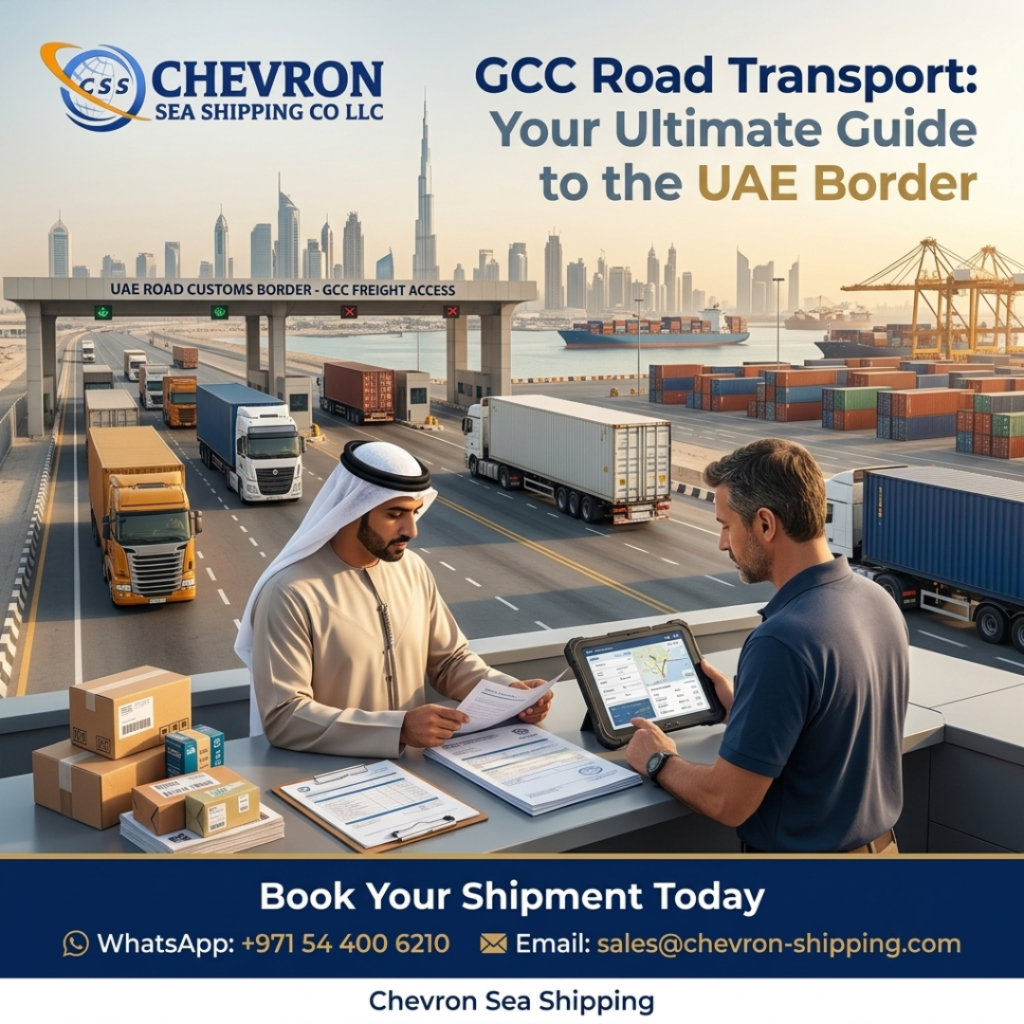
First, this guide covers vital freight logistics across the Middle East. Currently, the UAE serves as the primary shipping point for all regional imports. However, most logistics firms face a massive challenge. Specifically, handling export traffic from the UAE to other states requires mastering GCC Road Transport.
Moving cargo from the UAE into Saudi Arabia, Bahrain, Oman, and Kuwait is never simple. You cannot simply drive business trucks across a trade border. Instead, this export traffic remains highly regulated and incredibly intensive in paperwork. For example, missing unique Al Batha border crossing paperwork leaves your trucks marooned in the desert for days. Consequently, this results in massive demurrage costs and destroys your scheduled delivery completely.
At Chevron Sea Shipping, our land transport division handles massive daily movements of cross-border freight. Below, we outline the key aspects of successful freight logistics across the region.
1. Mastering GCC Road Transport: FTL or LTL
First, you must strictly ensure you select the appropriate transport method. Ultimately, your choice must perfectly match your shipment volume.
- Less Than Truckload (LTL): Companies frequently ship varying amounts of freight. Therefore, you should never pay for a full truckload when sending a partial shipment. Instead, we safely combine freight from different companies bound for the exact same destination.
- Cost Efficiency: Although LTL transit times often take longer due to consolidation, they remain highly cost-effective for SMEs. Consequently, LTL shipments allow you to manage your inventory highly efficiently.
2. The “Makasa” Exemption: Preventing Double Taxation
Customs duties always present major challenges for regional logistics. Because the GCC functions as a unified customs union, strict rules apply. Therefore, shipments entering the UAE (incurring a 5% customs duty) cannot legally incur another customs duty when entering Saudi Arabia or Oman.
- The Makasa System: To completely prevent double taxation, your logistics provider must process a Makasa (Statistical Customs Declaration). This vital declaration officially proves you paid the 5% duty at the first point of entry. Ultimately, it allows your shipment to cross the destination border entirely duty-free.
- The Trap: Unfortunately, if your freight forwarder fails to process the Makasa stamp properly during transit, disaster strikes. Specifically, customs will absolutely force you to pay the duties twice. Consequently, this heavily damages your bottom line.
3. Surviving the Saudi Border: SABER and Compliance
Saudi Arabia represents the biggest market in the region. However, it absolutely features the most challenging border crossing requirements. Relaxed border crossings are officially over. Currently, KSA strictly enforces fully digitized compliance.
- SABER Integration: First, shipping commercial goods to Saudi Arabia remains completely impossible without using SABER. Therefore, every single product must hold a Shipment Certificate of Conformity (SCoC) and a Product Certificate of Conformity (PCoC) from a certified body long before the truck reaches the Saudi border.
- SFDA Approvals: Furthermore, if your shipment contains food, medicine, or cosmetics, you face extra rules. Specifically, you must obtain additional approval directly from the Saudi Food and Drug Authority (SFDA). Fortunately, our customs team electronically obtains these approvals early. Thus, we allow our trucks to safely cross the Al Batha border with minimal interruptions.
4. Customized Fleets for Customized Cargo
The severe Middle Eastern climate and the specific nature of your goods directly determine your required transport equipment.
- Temperature-Controlled Reefers: Brutal desert temperatures of 45°C will quickly destroy your FMCG, chocolates, or pharmaceuticals. Therefore, we utilize advanced refractive trailers. Furthermore, GPS continuously monitors these units directly from Dubai to Doha.
- Low-Bed and Flatbed Trailers: Conversely, large industrial goods and construction materials simply cannot fit inside standard trailers. For these massive items, we actively utilize specialized low-bed and flatbed trailers featuring extra securing and lashing protocols.
Don’t Let Borders Become Bottlenecks
Crossing borders across the region remains a highly demanding practice. Therefore, it absolutely requires a dedicated customs compliance partner. You desperately need specific documentation, highly reliable fleets, and deep experience to avoid border delays completely.
If you need LTL consolidations to Muscat or FTL reefers to Riyadh, Chevron Sea Shipping provides the perfect solution. Indeed, we possess the regional reach and strict compliance expertise you truly need.
Contact our land transport division today for a tailored road freight plan.
- 📞 Direct Line / WhatsApp: +971 54 400 6210
- 📧 Email: [email protected]