

In healthcare logistics, shipping delays directly impact patient care. Therefore, the fast transport of surgical equipment remains vital.
Currently, the United Arab Emirates boasts a highly sophisticated healthcare sector. To maintain this world-class standard, the UAE strictly regulates medical imports. Consequently, you cannot simply load an MRI machine into a shipping container. Indeed, you cannot assume it will clear Jebel Ali Customs easily.
First, the Ministry of Health and Prevention (MOHAP) heavily scrutinizes every single medical item. If your documentation lacks detail, customs will seize your high-value equipment immediately at the border.
At Chevron Sea Shipping, our healthcare division safely transports delicate medical assets. Therefore, distributors and hospital officers must fully understand these strict rules. Below, we explain exactly how to import medical equipment safely into the UAE.
1. The Mandatory First Step: MOHAP Registration
First, you must register your product and company. You must complete this before booking any shipping vessel.
- Local Representation: Foreign manufacturers cannot import medical devices directly. Instead, you must act as a registered local UAE distributor. Alternatively, you must hold a valid MOHAP medical warehouse license.
- Device Registration: Furthermore, MOHAP must approve and register the specific medical device. To achieve this, you must prove the device acts safely and effectively. For instance, you need FDA Approval from the US or CE Marking from Europe.
2. Knowing the Classification of Devices
MOHAP strictly classifies medical devices based on patient risk levels. Consequently, higher risks dictate more complex import paperwork.
- Class I (Low Risk): This group includes simple items. For example, it covers surgical masks, bandages, and manual wheelchairs.
- Class IIa & IIb (Medium Risk): This category includes delicate syringes and ultrasound machines. Additionally, it covers powerful surgical lasers.
- Class III & IV (High Risk): Finally, this group contains critical life support devices. Specifically, it includes pacemakers and advanced neurosurgical implants.
- Crucial Note: Ultimately, this classification dictates your exact paperwork. It specifically determines which clinical reports and quality certificates customs requires.
3. The “Holy Trinity” of Import Documentation
To clear UAE customs smoothly, your broker desperately needs flawless origin documents. Unfortunately, any missing stamp will instantly hold up your shipment.
- Certificate of Free Sale (CFS): First, the origin health authority issues this document. Essentially, it proves you legally sell the product in that specific market.
- Certificate ISO 13485: Second, this provides vital proof of manufacturer compliance. It formally confirms the factory meets international medical quality standards.
- Letter of Authorization: Finally, the manufacturing company writes this legal document. It officially appoints the local UAE company as the registered distributor.
4. Cold Chain and Sensitive Transportation
Medical equipment often acts very delicately. Furthermore, it remains extremely sensitive to the brutal Middle Eastern climate.
- IVDs & Reagents: Many diagnostic testing kits require strict cold storage. Typically, they need precise temperatures between 2°C and 8°C. Therefore, we use active reefer containers. Furthermore, we deploy specific cold-chain protocols to prevent complete material degradation.
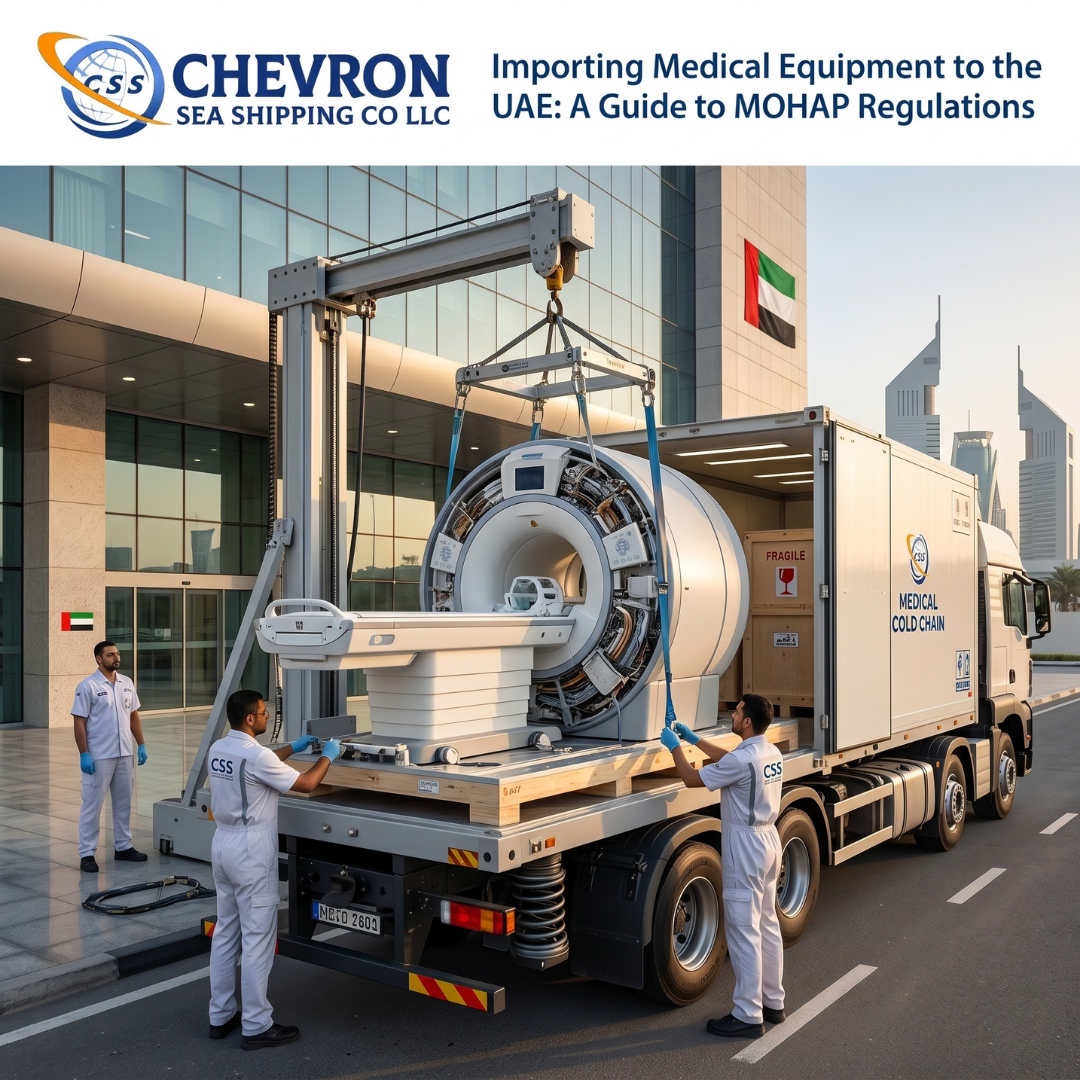
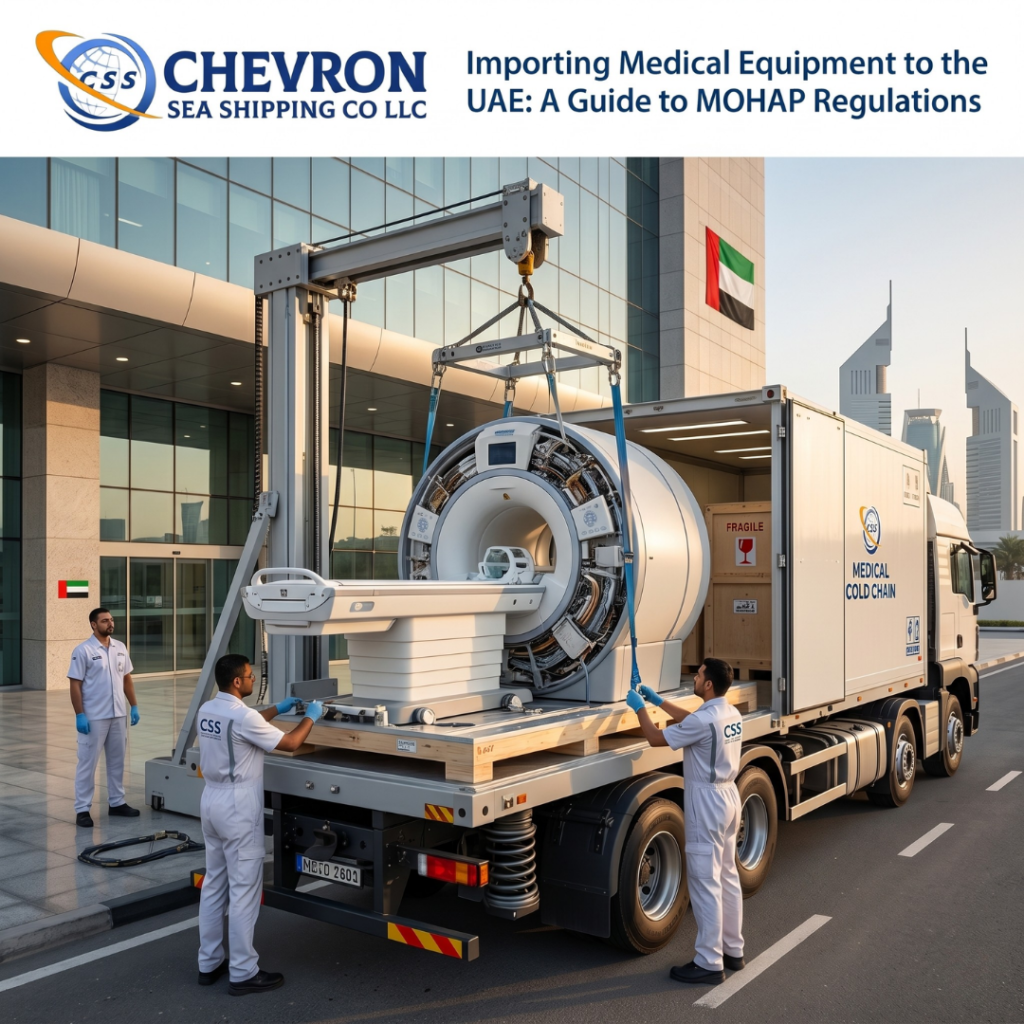
- Heavy Diagnostic Machines: Transporting a multi-million dirham MRI scanner requires special care. Specifically, we use shock-absorbing air-ride suspension trucks. These machines feature highly calibrated, delicate magnets. Consequently, a single heavy highway bump can ruin them completely. Thus, our heavy-lift teams carefully transport and rig this equipment directly into hospital radiology departments.
5. Fast-Track Customs Clearance
Basically, hospitals absolutely cannot afford to wait.
Therefore, we aggressively implement pre-clearance procedures via the Dubai Trade portal. First, we submit all MOHAP approvals and commercial invoices electronically. We do this long before the cargo even arrives. As a result, we fast-track medical shipments seamlessly. Ultimately, this minimizes storage time and gets equipment directly to the clinical floor.
Deliver Health Safely with Chevron
The healthcare supply chain requires zero tolerance for errors. Therefore, do not risk your medical assets with standard freight forwarders. Usually, they fail to understand strict MOHAP bureaucracy.
Instead, let the logistics specialists at Chevron Sea Shipping handle your medical imports perfectly. Indeed, we provide the compliance, speed, and exact care they truly deserve.
Contact our medical logistics division today to discuss your healthcare supply chain needs.
- 📞 Direct Line / WhatsApp: +971 54 400 6210
- 📧 Email: [email protected]