

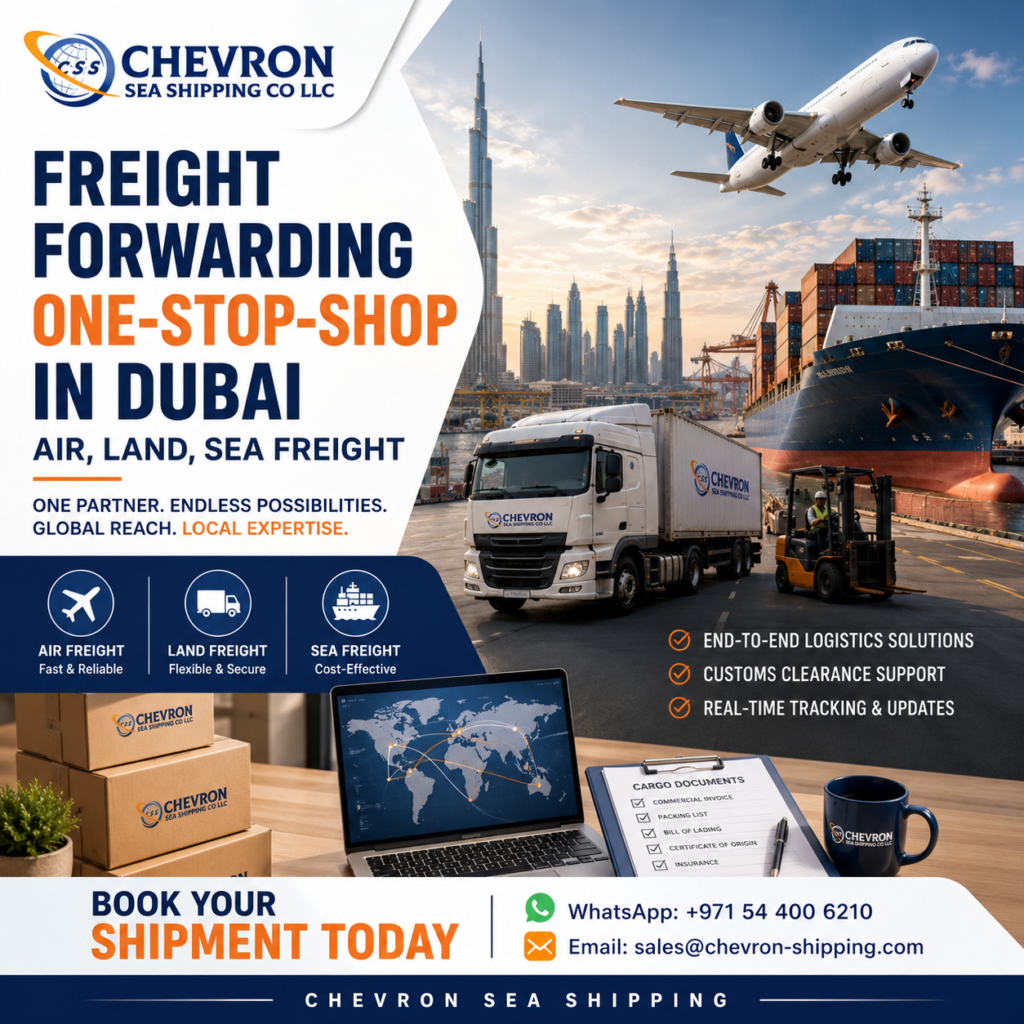
First, Dubai positions itself exceptionally well across major East-West trade routes. Consequently, the emirate serves as a vital global hub for international business. Therefore, securing reliable Freight Forwarding in Dubai is essential for the supply chain of large manufacturers exporting within the GCC, as well as for families relocating to the UAE.
Keeping track of complex shipping schedules often creates significant challenges during international shipping. Furthermore, navigating local customs regulations can feel just as daunting as ensuring your shipment arrives on time. Fortunately, partnering with the right experts will instantly ease the burden of global shipping. Below, this guide explores what sea, air, and land logistics entail. Ultimately, it helps you select the perfect logistics partner.
Understanding Freight Forwarding in Dubai
Freight forwarding involves coordinating the complete transport of cargo to its final destination. Similar to travel agents who organize complex trips, freight forwarders assemble the logistics puzzle. Specifically, they negotiate directly with a multitude of ocean shipping lines, airlines, and trucking companies.
Leading freight shipping companies provide full-spectrum services. Beyond basic cargo transport, top providers manage fulfillment at their facilities using 3PL warehousing solutions. Furthermore, they handle Dubai customs clearance, protective packing, and final door-to-door delivery. Consequently, they cater seamlessly to both commercial traders and individual customers.
Who Needs Freight-Forwarding Solutions?
Almost every sector requires the specialized services of logistics experts. A quality forwarder serves a wide variety of clients:
- Commercial Businesses: First, companies that regularly import and export raw materials rely on structured global freight.
- Exporters and Importers: Next, traders depend heavily on reliable cross-stuffing, breakbulk handling, and shed services.
- Expats and Families: Furthermore, families frequently require seamless local moves within Dubai Marina, Downtown Dubai, or Dubai Sports City, as well as international relocations.
- Office and Procurement Managers: Additionally, corporate teams need dedicated support to execute office relocations, transport sensitive equipment, and assemble office furnishings.
- Specialized Industries: Finally, sectors requiring tailored solutions for event exhibitions or moving heavy project cargo demand expert freight forwarders.
Options for Freight Forwarding in Dubai: Air, Land, and Sea
The transport mode you select depends heavily on your budget, cargo volume, and timeline. Each freight option offers distinct strategic advantages.
1. Dubai Sea Freight
When you manage a large volume of cargo and require an economical solution, sea freight serves as the absolute best option. Indeed, ocean transport remains the heart of international trade.
- Best For: Larger cargo, project cargo, breakbulk items, and complete household effects for international moves.
- How It Works: You can select between FCL and LCL ocean freight. Specifically, Full Container Load (FCL) allows you to lease an entire container, while Less than Container Load (LCL) lets you share space. Although ocean transit takes longer than air transport, it remains significantly cheaper for heavy goods.
2. Air Freight Dubai
When speed is your top priority, air freight leverages Dubai’s world-class airports to reach almost any global destination in record time.
- Best For: High-value goods, perishable inventory, urgent documentation, and time-sensitive commercial shipments.
- How It Works: Air transport utilizes commercial flights or specialized cargo charters. Although air freight costs more than ocean shipping, it provides unmatched reliability, strict security, and drastically reduced transit times.
3. Land Freight UAE
- Best For: Local relocations, door-to-door cargo deliveries, and cross-border transport across GCC countries like Saudi Arabia, Oman, and Bahrain.
- How It Works: Utilizing specialized fleets, GCC road transport deploys flatbeds, box trucks, and climate-controlled reefers to connect key regional destinations.
The Freight Forwarding Process: A Step-by-Step Guide
Working with professional logistics teams simplifies the intricate shipping process into clear, manageable steps:
- Consultation and Planning: First, logistics experts thoroughly evaluate your cargo’s size, weight, and destination to recommend optimal transport modes.
- Quotation: Next, you receive a transparent cost breakdown along with clear documentation requirements.
- Packing and Preparation: Subsequently, specialized teams arrive on-site to secure your items. Furthermore, high-value goods receive custom wooden crating.
- Export Customs Clearance: Following packing, the forwarder’s internal team manages export customs processing.
- Transit: Next, workers load your goods onto the designated vessel, aircraft, or vehicle, with continuous monitoring throughout transit.
- Destination Clearance and Delivery: Finally, destination customs are cleared, and cargo is delivered to your final address. For relocations, this step often includes complete unpacking and furniture positioning.
Important Shipping Documents
Customs paperwork leaves absolutely no room for error. Mistakes inevitably cause frustrating shipment delays. Although your forwarder handles the heavy lifting, you must provide the following:
- Commercial Invoice: A detailed description of the goods and their exact commercial values.
- Packing List: A detailed account of package contents, dimensions, and total weights.
- Bill of Lading / Air Waybill: The official transport contract and legal receipt of goods.
- Certificate of Origin: Formal proof stating the country where goods were manufactured.
- Identification Documents: A valid trade license for commercial cargo, or passport and visa copies for personal relocations.
Note: Final transit timelines, documentation rules, and overall costs depend heavily on the carrier, destination, and local government customs processing.
Common Pitfalls in Logistics
Navigating global logistics can prove challenging. However, avoiding these common mistakes will save you significant time and money:
- Basing Decisions Solely on Cost: Unusually low quotes frequently cut corners on safe handling and insurance, which leads to hidden destination fees later.
- DIY Packing for Fragile Goods: Packing delicate items without professional materials frequently leads to damage. Always rely on specialized crating services.
- Ignoring Import Laws: Every country enforces unique customs regulations. Shipping prohibited items can result in severe fines or cargo seizure.
Why Partnering with a Logistics Specialist Makes Sense
Hiring a professional logistics provider allows you to focus completely on your core business operations. Furthermore, modern logistics partners handle everything from risk management to cross-stuffing. If you are launching a regional brand alongside these physical operations, pairing strong logistics with high-converting digital marketing assets ensures both your fulfillment and sales engines run at peak efficiency.
Why Choose Chevron Sea Shipping Co. L.L.C?
Located strategically in Al Garhoud, Chevron Sea Shipping Co. L.L.C stands among the most trusted logistics companies in the UAE. We design end-to-end, customized logistics solutions for both commercial enterprises and individual clients. Furthermore, our experienced teams handle complex exhibition logistics for events at the Dubai World Trade Centre with total precision.
We maintain an unyielding commitment to safety, speed, and regulatory compliance. If you are scaling an online storefront, aligning your supply chain with effective e-commerce marketing strategies guarantees seamless customer experiences from click to delivery.
Streamline your global supply chain with Chevron Sea Shipping today!
- 📞 Direct Line: +971 4 2888700
- 📱 WhatsApp: +971 58 8257577
- 📧 Email: [email protected]
Frequently Asked Questions (FAQs)
1. What are the main differences between a freight forwarder and a shipping line?
Shipping lines own and operate the physical vessels that transport ocean cargo. Conversely, a freight forwarder acts as an expert architect who books space across shipping lines, airlines, and trucking fleets while managing customs, packing, and warehousing.
2. When should I consider using air freight over sea freight?
Sea freight is the most economical choice for heavy, bulky cargo that is not time-sensitive. Conversely, air freight is ideal for high-value, perishable, or urgent shipments where speed and security outweigh transport costs.
3. Do you assist with both commercial cargo and personal relocation services?
Yes. We provide comprehensive B2B commercial logistics—including project cargo and exhibition logistics—alongside B2C personal services such as local, corporate, and international relocations.
4. What does door-to-door cargo delivery mean?
Door-to-door delivery means we manage every single logistical step. From collecting cargo at your origin address to clearing customs and delivering to your final destination address, we handle the entire process.
5. Do you offer custom packing services and protective materials?
Yes. Our team provides professional packing using high-grade materials. Furthermore, we construct custom protective wooden boxes for fragile or exceptionally valuable assets.