

First, consider the most devastating misconception in the moving industry. People often think, “If the moving company breaks my TV, they must buy me a new one.”
Logically, that idea makes total sense. However, international maritime shipping does not work that way legally. Indeed, strict international transport laws strongly protect shipping lines when you sign a contract.
Therefore, you must understand the difference between Mover’s Valuation and Freight Insurance. Otherwise, a damaged shipment could leave you with thousands of dirhams in losses. Moreover, you might only get a settlement check for a few coins.
At Chevron Sea Shipping, we believe our clients deserve absolute transparency before their goods leave Dubai. Below, we provide a plain-English breakdown of how companies actually protect your cargo. Ultimately, you must read the fine print.
1. Mover’s Valuation (The Default Trap)
Usually, a moving company includes a default level of liability in your quote. Experts call this “Valuation.” Importantly, Valuation is absolutely not insurance.
- How it Works: First, international maritime law dictates this tariff-based limit of liability. Specifically, it calculates compensation solely based on an item’s weight or volume. Consequently, it completely ignores the actual monetary or sentimental value.
- The Weight Penalty: Unfortunately, standard international valuation often limits liability to an incredibly low figure. For instance, it might pay just a few dollars per kilogram.
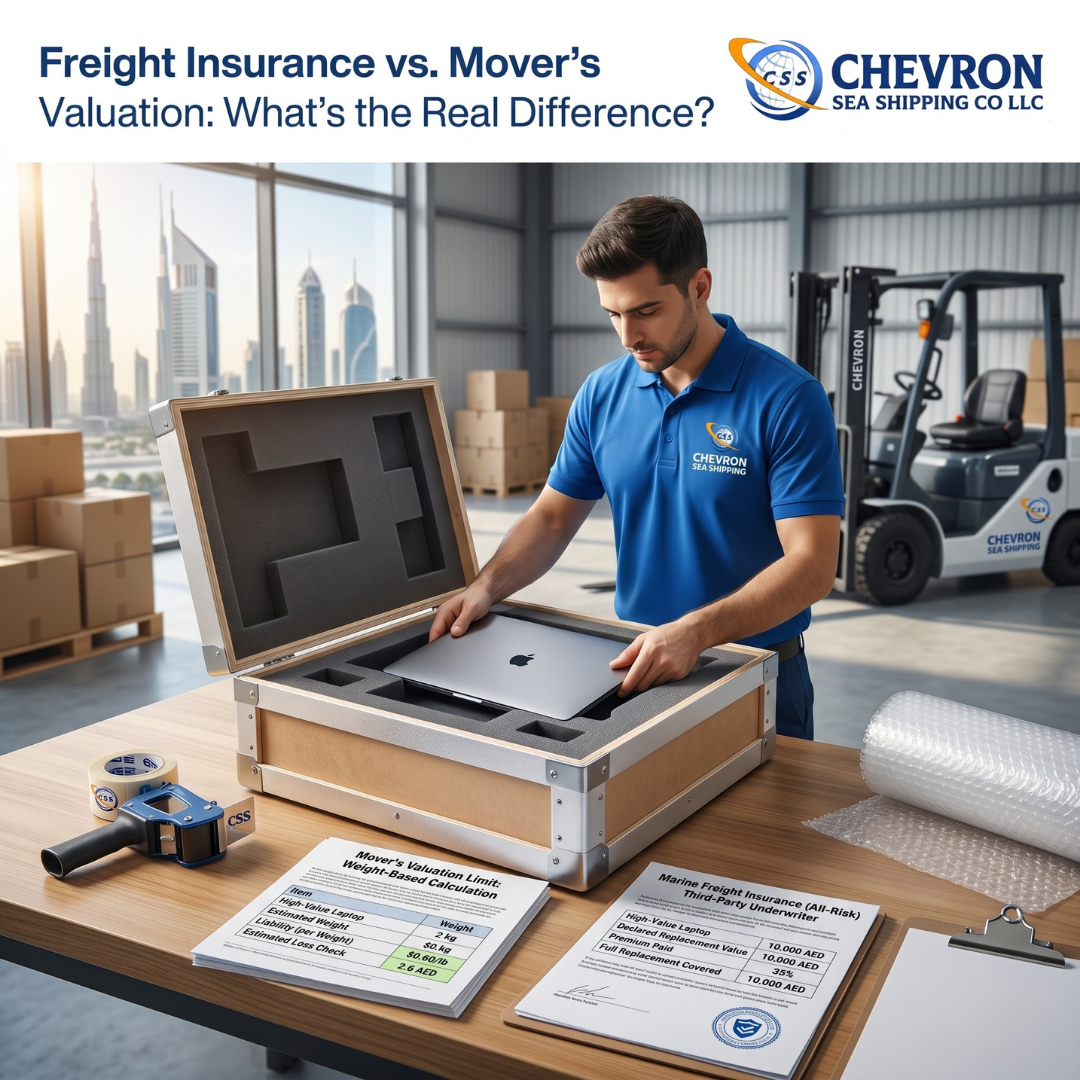
- The Nightmare Scenario: Imagine you ship a brand-new MacBook Pro worth 10,000 AED. Generally, it weighs about two kilograms. If a forklift crushes that box at the port, the carrier faces limited legal obligations. Specifically, they only pay you for two kilograms of damaged freight. Therefore, you might receive a settlement check for 20 AED to replace a 10,000 AED laptop.
2. Marine Freight Insurance (The True Protection)
To get the actual replacement value of a damaged item, you must buy dedicated Marine Freight Insurance. Specifically, you need an “All-Risk” policy through a third-party underwriter.
- How it Works: First, you pay an insurance premium based on the total declared value. In return, the insurance underwriter agrees to cover the full replacement or repair cost. Therefore, they protect you against items lost, stolen, or damaged during transit.
- The Benefit: Consequently, if a forklift destroys that same 10,000 AED MacBook Pro, an All-Risk insurance policy protects you. It simply pays out the actual 10,000 AED. Finally, you can go to the store and buy a new one.
3. The “Packed-By-Owner” (PBO) Loophole
Even if you buy premium All-Risk insurance, you can accidentally void your coverage. This happens frequently if you try to cut corners on moving day.
- To save money, many clients want to pack their own boxes. Next, moving companies label these boxes as PBO (Packed By Owner) on the inventory list.
- The Trap: Unsurprisingly, insurance underwriters remain highly suspicious of PBO boxes. Because a professional did not inspect and pack the item, no proof exists. Therefore, you cannot prove the item worked before you packed it. Consequently, if a PBO box arrives completely shattered, the insurance company will almost always deny the claim.
- The Solution: Thus, if you want your goods fully insured against breakage, you must let professional moving crews pack your boxes.
4. The “Rule of Average” (Why You Cannot Under-Declare)
When you buy Marine Insurance, you must fill out a specific valuation form. This form details the replacement cost of your household goods.
- First, do not try to save money on your insurance premium by lying. For example, do not claim your 50,000 AED living room set only costs 10,000 AED.
- If you make a claim, the insurance adjuster will apply the “Rule of Average.” For instance, they might determine you insured your shipment for only 20% of its actual value. In that case, they will pay out only 20% of your claim. They will do this even if the item suffered total destruction. Therefore, always declare the true replacement value at your destination.
5. The “Total Loss” Warning
You must act carefully when comparing moving quotes. If a competitor offers you “Free Insurance,” you should look closely.
- Often, they only offer Total Loss Insurance.
- This policy only pays out if the entire container sinks into the ocean or catches fire. However, the container might arrive safely with smashed furniture inside. In that scenario, Total Loss insurance pays you absolutely nothing.
Ship with Absolute Certainty
Moving across the world causes enough stress without risking your financial assets.
At Chevron Sea Shipping, we absolutely refuse to hide behind legal jargon. Instead, we offer comprehensive, third-party “All-Risk” marine insurance policies for every move. Ultimately, we ensure your bank account remains fully protected if the unpredictable happens at sea.
Protect your next move. Contact our relocation specialists today for a fully insured, transparent shipping quote.
- 📞 Direct Line / WhatsApp: +971 54 400 6210
- 📧 Email: [email protected]