

Dubai serves as a famous business hub. People know it worldwide as tax-friendly. However, tax-friendly does not mean tax-free. You might import commercial goods. Alternatively, you might import high-value personal items. If you ignore the customs duty rules, you will lose profit.
First-time sellers often import electronics. Meanwhile, large companies import heavy construction materials. In both cases, the border brings a massive financial test. Moreover, calculating import taxes wrongly causes big problems. It leads to held cargo and high port fees. Also, it brings severe legal fines.
Our licensed customs brokers at Chevron Sea Shipping solve these issues daily. Therefore, we wrote this simple guide. Below, we explain how UAE customs duties truly work. Furthermore, we show you how to stay fully compliant.
1. The Standard Rule: The 5% Customs Duty
Generally, commercial goods face a 5% import tax in the UAE mainland.
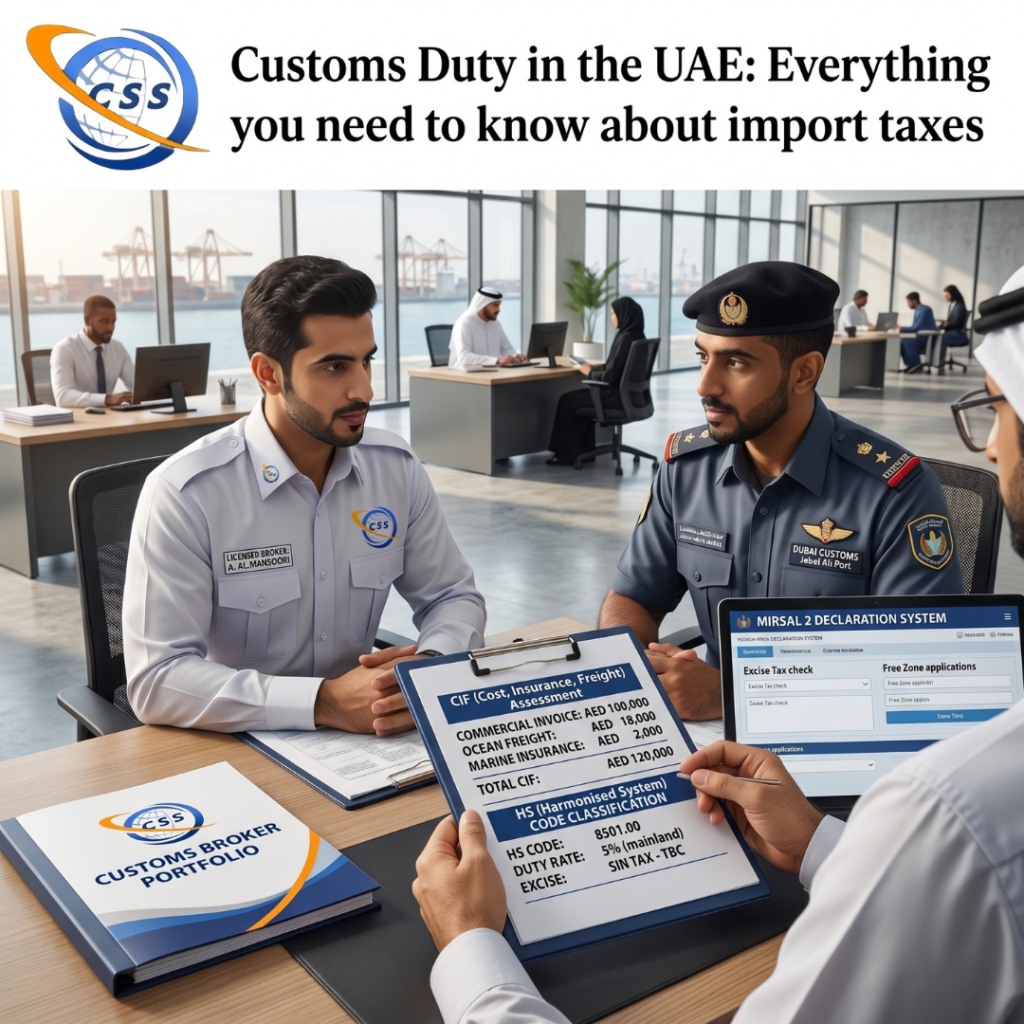
- The Catch (CIF Valuation): Customs does not just tax the item’s price. Instead, they use the CIF value. CIF means Cost, Insurance, and Freight. Therefore, you pay 5% on the total invoice, marine insurance, and freight costs combined.
- The Reality Check: For example, you buy goods worth AED 100,000. Next, you pay AED 20,000 to ship and insure them. Consequently, customs calculates your 5% tax on AED 120,000.
2. Remember the 5% VAT
The UAE launched a Value Added Tax (VAT) in 2018. It applies to almost everything entering the country.
- The Formula: Customs calculates the 5% VAT on the total CIF value plus the paid customs duty.
- TRN Registration: Does your business have a Tax Registration Number (TRN)? If so, our broker links your import papers to your TRN. As a result, you can reclaim this import VAT later on your company’s tax returns.
3. The Heavy Hitters: Excise Taxes (Sin Taxes)
Not all goods face the same taxes. The UAE government applies heavy “Excise Taxes” on harmful products. Be ready to pay extra if you import these items.
- 100% Tax: This high tax hits tobacco, electronic smoking devices, and energy drinks.
- 50% Tax: This tax applies to carbonated drinks and sugary foods.
- Action Step: If you sell these items, you must register with the Federal Tax Authority (FTA) first. You must do this before you import them.
4. Loopholes: Duty Exemptions and Free Zones
You can legally avoid the standard 5% tax if you meet specific rules.
- Free Trade Zones (FTZs): Sometimes, you import goods directly into a Free Zone like JAFZA. If you re-export them later, you pay zero duty. However, you must pay the tax if you move those goods into the local UAE mainland.
- Personal Effects: Expats moving to the UAE can bring used household goods duty-free. You just need a valid residency visa. Also, you cannot sell these personal items for profit.
- GCC Agreements: Some goods come from GCC countries. Others come from countries with UAE trade deals (CEPAs). These goods enter 100% duty-free if you show a valid Certificate of Origin.
5. The Essential Paperwork (No Room for Error)
Your paperwork must look perfect. Otherwise, customs will not clear your goods. Dubai Customs demands several key documents.
- Commercial Invoice: This paper must show the exact quantity, description, and true value. Do not lie about the item’s value. This mistake causes heavy fines.
- Packing List: This document details the specific weight and size of your items.
- Certificate of Origin: The Chamber of Commerce in the origin country must stamp this document.
- Transport Document: You need a Bill of Lading for sea freight. Alternatively, you need an Airway Bill for air freight.
Stop Guessing with Your Margins
Stop guessing with your profit margins. A tiny error on a customs code can ruin a 0% tax exemption. Do not leave your commercial imports to chance.
Our dedicated customs team at Chevron Sea Shipping helps you classify goods perfectly. Furthermore, we handle your Mirsal 2 declarations. Ultimately, we ensure you only pay the exact legal tax required.
Contact our customs team today to calculate your next import cost.
- 📞 Direct Line / WhatsApp: +971 54 400 6210
- 📧 Email: [email protected]